
Karl Marx his religious view
as seen by his wife & daughter
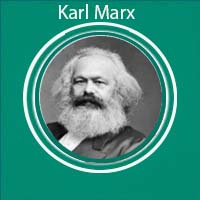
Karl Marx: A Brief Biography
Karl Marx was born on May 5, 1818, in the ancient city of Trier, located in the Kingdom of Prussia (modern-day Germany). He was born into a middle-class family; his father, Heinrich Marx, was a successful lawyer and a passionate supporter of Enlightenment ideals, who had converted the family from Judaism to Lutheranism shortly before Karl’s birth to avoid discriminatory laws blocking his legal career.
His Education
Marx received a rigorous classical education, attending high school at the Gymnasium zu Trier before matriculating at the University of Bonn in 1835 as a law student. After a rowdy year there involving duels and a brief arrest for public drunkenness, his father pushed him to transfer to the highly academic University of Berlin. In Berlin, his interests shifted sharply toward philosophy and history, leading him to join a radical group of thinkers called the “Young Hegelians.” He completed his studies by receiving a doctoral degree in philosophy from the University of Jena in 1841.
Places He Lived
Because of his revolutionary journalism, political subversion, and anti-government writings, Marx spent much of his adult life fleeing state authorities, living across several major European cities:
- Cologne, Germany (1842–1843): Where he ran his radical newspaper, the Rheinische Zeitung, until it was heavily suppressed and banned by the Prussian government.
- Paris, France (1843–1845): A vibrant hub for socialist thinkers where he first met his lifelong collaborator Friedrich Engels. He was eventually expelled by French authorities at the request of the Prussian state.
- Brussels, Belgium (1845–1848): Where he lived in political exile, renounced his Prussian citizenship to become entirely stateless, and co-wrote the legendary pamphlet The Communist Manifesto.
- London, England (1849–1883): His final home. After being driven out of continental Europe following the Revolutions of 1848, he spent the rest of his life living in London, writing his economic masterwork Das Kapital while working daily in the reading room of the British Museum.
His Death
Marx lived his final decades plagued by failing health, deep poverty, and the loss of his beloved wife, Jenny. He passed away from complications of bronchitis and pleurisy at the age of 64 on March 14, 1883, in London. He was laid to rest at Highgate Cemetery, where his monument remains a global historic landmark today.
Karl Marx on Religion and the Divine
What Marx Actually Meant (Beyond the anti religion quote)
First, the actual quote from his 1844 introduction to A Contribution to the Critique of Hegel’s Philosophy of Right is often shortened, changing its meaning. He did not say religion was the opium, but rather:
“Religion is the Opium of the people was:-”
“Religion is the sigh of the oppressed creature, the heart of a heartless world, and the soul of soulless conditions. It is the opium of the people.”
Blog Guy..
I wrote this blog July 2026
Small input, like so many things written in ‘times of old’ they become out of context, and re-purposed to suite some ones bias, for an example, a News Journalist in America remarked at how many photographs there are on Jeffrey Epstein and Donald Trump, Donald Trump having said, he hardly knew the guy, the made the point that this is a time before everyone took pictures on their mobile phones, you would have had to have taken a film or digital camera with you, this creates a completely different ‘take’ on Donald Trumps statement that ‘I hardly knew the guy’.
So when we look at Marx’s statement, even the abbreviated statement ‘Religion is the opium of the people’ we have to remember that the Established Church of the time and the rich and powerful controlled the population by beating the population with a religious stick, as 71% of the population went to church in those days, so we have to see it in context. In England, in my lifetime, the establishment dropped a verse from the Hymn ‘All Things Bright and Beautiful’, Quote The rich man in his castle, the poor man at his gate, God made them high and lowly, and ordered their estate. Imagine that!
Marx wasn’t treating religion as an evil scam invented by priests to trick people. He looked at it like a 19th-century doctor looked at medical opium: a powerful painkiller. To Marx, human suffering was caused by brutal economic conditions and poverty and the poor distribution of wealth. Religion was a natural human reaction to numb that pain—a way to dream of a “heavenly paradise” in some future, a promised future of happiness, because the real world was so agonizing.
His logic was simple: if you want a patient to stop taking a heavy painkiller, you don’t just snatch the medicine away; you heal the physical wound causing the agony. If you fix society so people aren’t oppressed, the psychological need for religion will naturally melt away.
Insights From His Wife: Jenny von Westphalen
Marx’s wife Jenny came from an aristocratic Prussian family with highly religious, conservative relatives. Choosing to marry Karl meant embracing poverty, political exile, and a household of radical atheists.
In her letters, Jenny reveals that the family viewed religion as an ideological tool used by the ruling elite to justify inequality. She deeply resented her family’s upper-class pietism. She wrote bitterly about her relative Ferdinand (who became a highly reactionary Prussian Minister) and others:
“…their pietistic-aristocratic relatives to whom the Lord in Heaven and Lord in Washington are equal objects of veneration…”
To Jenny, traditional religious devotion among the wealthy was tightly bound to protecting their property and status. She fiercely backed her husband’s work because she believed the true salvation of humanity lay in concrete economic liberation, not church dogma.
Insights From His Daughter: Eleanor “Tussy” Marx
Marx’s youngest daughter, Eleanor, grew up inside the family’s London exile home while Marx was writing Das Kapital. She became a massive political force in her own right, organizing trade unions and translating literature.
Eleanor was a resolute, outspoken secularist and atheist. She directly carried her father’s philosophical views into her public life, once stating to a contemporary:
“We want to make them disregard the mythical next world and live for this world, and insist on having what will make it pleasant to them.”
Eleanor’s words perfectly sum up the core of Marxist secular philosophy: shifting human hope away from an unseen judge in the sky and forcing people to take full accountability for making life fair and beautiful right here on earth.