
It appeared that cause came after the effect
 It appeared that cause came after the effect.
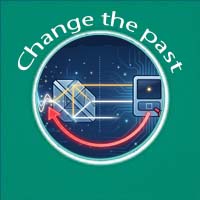
In this experiment, a photon was sent through a system of detectors and then later researchers decided how to measure that. But here’s the deal. The later measurement affected the photon’s past state. In other words, it appeared that cause came after the effect. So a particle would change its state in the past when experimenters altered conditions in the future, which they called “retrocausality.”
Imagine: you make a choice today, and the world seems to rewrite yesterday to match it. This isn’t science fiction, it’s a documented phenomenon that leaves physicists scratching their heads. One scientist said, ‘It’s like the Universe knows what we’re going to do before we even do it.’
Now it is not as if the little electrons ran back and changed something that had been set in stone. Retrocausality, physicists say, isn’t actually happening the way it sounds. What does happen is that quantum particles exist in a state of undefined multiple possibilities until a measurement is made—even when the measurement is made later.”
The Real Science Behind the Post
If you want to look up the actual physics that inspired her talk, she is referring to Wheeler’s Delayed-Choice Experiment, a famous thought experiment in quantum mechanics proposed by physicist John Archibald Wheeler in 1978 (and later proven in real labs).
In the quantum world, particles like photons act like a wave of “probabilities” until they are forced to choose a solid state by being measured. Wheeler’s experiment proved that deciding how to measure a photon at the very last second forces it to behave either as a wave or a particle—retroactively deciding the path it “must” have taken through the equipment earlier.
While it sounds like rewriting history, physicists generally agree it doesn’t allow us to send signals or changes into the past; rather, it shows that nature doesn’t have a definite, fixed reality until we observe it!