
Ramana Maharshi (1879–1950) did not have a human Guru. His awakening at age sixteen came spontaneously through a profound death-like experience, after which he realized the Self. From then on, he regarded the sacred mountain Arunachala in Tamil Nadu as his Guru, seeing it as the embodiment of divine consciousness and the silent teacher that guided his life.
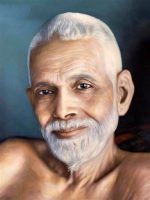 Ramana Maharshi’s Guru – The Silent Mountain Arunachala
When we think of spiritual masters, we often imagine disciples learning at the feet of a revered teacher. Yet, Ramana Maharshi’s Guru was not a person, but a mountain—Arunachala. At sixteen, Ramana underwent a sudden inner transformation, experiencing the dissolution of his ego and awakening to the eternal Self. Soon after, he journeyed to Arunachala, where he remained for the rest of his life.
For Ramana, Arunachala was no ordinary peak. He described it as the “Heart of the world” and the living presence of Lord Shiva. In his hymns, he wrote: “Arunachala! Thou dost root out the ego of those who meditate on Thee in the heart.” This silent Guru required no words, only presence. Ramana often emphasized that silence itself is the highest teaching, and Arunachala embodied that truth.
Ramana’s sayings reflect this deep connection:
- “The Guru is within. You seek outside because you are ignorant of that fact.”
- “Silence is the true teaching. It is the perfect language of the Self.”
Thus, Ramana Maharshi’s Guru was not a man but the eternal stillness of Arunachala, guiding seekers to discover the Self within.