
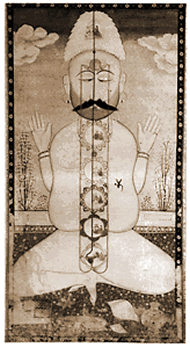
 Patanjali: The Sage Who Systematized the Path to Inner Freedom
A Brief Biography of Patanjali
Patanjali is a revered figure in the spiritual and philosophical traditions of ancient India. Though the exact details of his life remain cloaked in mystery, scholars generally place him between the 2nd century BCE and the 4th century CE. He is best known as the compiler of the Yoga Sutras, a foundational text that codified the philosophy and practice of yoga into a coherent system.
Often referred to as the “Father of Classical Yoga,” Patanjali was more than a yoga teacher—he was a philosopher, mystic, and grammarian. Some traditions even regard him as an incarnation of the divine serpent Adi Sesha, symbolizing timeless wisdom.
The Yoga Sutras: A Manual for Liberation
Patanjali’s Yoga Sutras consist of 196 concise aphorisms (sutras) that outline a practical path to spiritual liberation. The text is divided into four chapters:
- Samadhi Pada – On the nature of consciousness and the goal of yoga: union with the divine.
- Sadhana Pada – On disciplined practice, including the Eight Limbs of Yoga.
- Vibhuti Pada – On the extraordinary powers that arise from deep meditation.
- Kaivalya Pada – On ultimate liberation and the transcendence of the ego.
Patanjali’s Core Philosophies of Life
1. The Eight Limbs of Yoga (Ashtanga Yoga)
Patanjali’s most enduring contribution is the eightfold path, a step-by-step guide to spiritual evolution:
| Limb | Meaning & Practice |
|---|---|
| Yama | Ethical restraints (e.g., non-violence, truthfulness) |
| Niyama | Personal observances (e.g., contentment, self-discipline) |
| Asana | Physical postures to prepare the body for meditation |
| Pranayama | Breath control to regulate life force |
| Pratyahara | Withdrawal of the senses to turn inward |
| Dharana | Concentration on a single point |
| Dhyana | Meditation and sustained awareness |
| Samadhi | Blissful absorption and union with the Self |
2. Mind as the Key to Liberation
Patanjali taught that the mind, when untrained, is the source of suffering. But when disciplined through yoga, it becomes the gateway to self-realization. His famous sutra—“Yoga chitta vritti nirodhah”—means “Yoga is the cessation of the fluctuations of the mind.”
3. Purusha and Prakriti
Patanjali’s dualistic worldview distinguishes between:
- Purusha: the eternal, unchanging consciousness (the true Self)
- Prakriti: the ever-changing material world
Liberation (kaivalya) occurs when one realizes their identity as Purusha, untouched by the dramas of Prakriti.
4. Daily Sadhana (Spiritual Practice)
Patanjali emphasized the importance of consistent practice—abhyasa—and detachment—vairagya. He believed that through daily meditation, ethical living, and inner inquiry, anyone could move toward enlightenment.
Why Patanjali Still Matters
Patanjali’s teachings are not bound by time or culture. They offer a universal roadmap for anyone seeking clarity, peace, and purpose. His Yoga Sutras are as relevant to the modern seeker navigating digital distractions as they were to ascetics in ancient forests.
For those of us blending ancient wisdom with modern life, Patanjali is a beacon—reminding us that the path to inner freedom begins not in renunciation, but in awareness.